

CREATE NEW HABITS:
CUT A NEW GROOVE
Bryan K. Nichols, Ph.D.
 We all have habits, patterns, or issues that we wish to change, such as managing our relationships with others, our weight, strong emotions, or our work accomplishments. For many people, these habits are so troubling they wish they could have them removed from their psyche, like some sort of modern day “psycho-surgery”.
I have contended for many years that as much as we wish that un-helpful habits could literally be removed from our brains, the unfortunate truth is that these habits have been ingrained in us so long through repeated practice that it is unlikely that they could ever be changed. It’s as though these patterns, which consist of how we think, feel and act, “cut a groove” in our brains, forming a circuit that gets easier to access and moves faster each time we repeat the pattern. It eventually happens so quickly that it feels automatic and unchangeable. Advances in science confirm that our actions can be traced with instruments that measure brain activity, and that many of our habits do in fact have corresponding brain circuits.
So, if the unhelpful patterns can’t be removed, what hope do we have for positive changes? I believe that positive change and growth comes from creating new habits and patterns that create an alternate brain circuit that, over time, can compete with the old pattern and provide a powerful positive alternative. I refer to this as “cutting a new groove”. When we cut new grooves, we are literally establishing new circuits in the brain, and when we repeat the new, positive habits, we are ingraining this new groove, which is crucial if we ever hope for it to compete with our old, deeply ingrained, grooves. So, how do we cut these grooves.
CUTTING A NEW GROOVE IS HARD AT FIRST

A trail through the jungle thickly overgrown with plants and bushes.
Imagine for a moment that you are a villager in the amazon where your ancestors have lived for centuries. For hundreds of years, your people have walked the same path to the river. This path is well worn. There is no grass on the path and the thick vegetation of the jungle has receded around the path, accommodating the human form that frequently walks through it. It typically takes about an hour to get from the village to the river, a fact of life that people have simply accepted. But, in one of the odd strokes of life that sometimes occurs, you are visited by outsiders who wish to learn about your village. They reach your village by helicopter and begin speaking to you about life in your village. They take you in their helicopter so you can help them understand the typical movement patterns of the villagers. However, while in the helicopter, you look down upon the terrain you’ve walked for years and notice that your well-worn path to the river is incredibly inefficient and long. It is obvious to you that you could arrive at the river in half the time if you took a left turn at one distinct point of the path. The problem, of course, is that to take this new route requires going through very thick jungle. It is a daunting task indeed, and to try it the first time would probably take 10 times as long as usual, and would be very hard work. But, once a new path is established, it can cut that walk in half.
At sunrise the next day, you go to the path with your trusty machete in hand, and at that crucial “switch point” in the path, you begin cutting. It’s hard, but your conviction to create something new and helpful for yourself and your village spurs you along. Despite your motivation to make things better, you consider quitting at several points in the day because of the sheer difficulty of the labor. However, you talk yourself through these moments of doubt, and just prior to sun down, you find yourself at the river.
You’ve done it! You’ve created a new path that can now make everyone’s life easier.
WITH NEW GROOVES, ITS “USE IT OR LOSE IT”
To your surprise, your family and friends don’t jump up and congratulate you on this amazing new path you’ve cut. People are creatures of habit and don’t readily trust new things. They’re doubters! They remain inclined to take the old path because that’s what they know. As it turns out, you have to do more than just cut the path to make things better for you and the villagers. You have to push and motivate people to go down that path, and they need to do it sooner rather than later. This is very fertile jungle. If no one goes through it, it won’t take long for the path to become overgrown.
Slowly but surely the villagers start taking the path and you notice that it starts to get bare on the ground. The vegetation gradually begins to recede, creating the outline of the human form. It gets easier and easier to go down this path. After a few months of using the new path, you notice that the old path starts to get a bit overgrown, not as bare, and definitely not as appealing to the villagers.
You’ve now created a viable alternative to the old path!

The General Theory
“Cutting a new groove” is a way of discussing and visualizing Cognitive Behavior Therapy, a long standing psychological approach to behavior change. The major components of this theory are:
Triggers – events or situations that happen to you
Thoughts – how you think about, or interpret the event or situation
Feelings – the emotions that occur in response to the thoughts
Actions – behaviors you demonstrate in response to thoughts & feelings
Results – consequences of your actions
A key belief of this approach is that thoughts cause feelings.
Often, when we are confronted with intense triggers, it seems that the trigger causes the feeling. For instance, if your friend curses at you, you might say that, “my friend made me angry”. But, suppose you thought that your friend cursed at you because your friend was having a reaction to a new medication. You might not feel angry. Instead you could feel sympathy. How you thought about or interpreted your friend’s outburst is what caused your feeling. Likewise, if you felt angry at your friend’s outburst it means you interpreted the cursing as unnecessary or unfair or mean, and that interpretation is what led to your angry feeling.
The idea that how we think about events is what causes our feelings and subsequent actions gives us choice and power. If we have responses to triggers that we believe are unhelpful, we may be able to change our responses if we can find different, and believable, ways to think about those triggers. Finding a different way to think about the trigger is the key to cutting a new groove.
But, the force of habit is powerful. Our thoughts about triggers often happen so automatically and quickly we don’t even recognize that we have them. This is why we need to step back, slow down and dissect the process, and then gradually build new thoughts and responses to triggers –
Cut a New Groove!
The 5 F’s
A Guide to Balanced Living
Bryan K. Nichols, Ph.D.

The 5F’s is a personal guide to balanced living that I evolved for myself over the course of about 10 years. I have shared this guide with many of my clients who have found them as helpful as I have.
As with many concepts I share, they come with a story…
It all started when I was a 24 year-old psychology graduate student attempting to balance work, school and the challenge of maintaining physical fitness. I began by renewing an old habit of running a mile most nights, then progressing to two. I would spur myself along by chanting, “Physical Fitness!”
When I ran, I contemplated how physical fitness was not all there is to a well-lived life. With the notoriously bare pockets of a graduate student, I began to spontaneously chant to myself, “Physical fitness – Fiscal Fitness!!”

It was not coincidental that I realized that fiscal fitness needed to become a crucial habit…
I was a child of the social movements of the 70’s and very sensitive to the plight of people living in and around the poverty line. I was adopted as an infant into a loving and upper middle class family. But, when I saw people struggling on the streets of my hometown Washington, D.C., I thought, “there but for the grace of God go I”. I couldn’t come to terms with the serendipitous arrangement by which I had been blessed by fate while others had not. My sense of unfairness about the social arrangement, mostly class and race disparities, spread to my view of money, which I saw increasingly as a corrupting influence, truly, “the root all evil”.
But then, in the early 1980’s, scrounging for the $20 necessary to take my girl to the movies and get a couple slices of pizza, I felt compelled to confront my money issues. I remember the day I called my mother and told her excitedly, “mom, I’ve come to realize that I have contempt for money, and that I need to get better with it!” She gasped in horror and uttered something like, “where did I go wrong?”
As I ran for the next few years I would recite my “Physical Fitness -Fiscal Fitness” chant. But then, life happened and I married that girl I took to the movies and pizza parlor. Suddenly, physical and fiscal didn’t seem to be enough.
I began to think, I really have to ensure that I devote adequate time and attention to my wife. But that attention to my wife can’t diminish my love and attention for my parents, sister, and beloved aunt. I began to realize that such attention can’t be taken for granted; I can’t assume it will just occur in the normal conduct of a busy, professional life. I have to be intentional about it!
I needed to commit myself to “Family Fitness”…
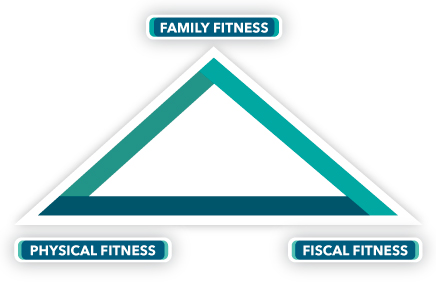
To this point I had developed the 3F’s of a well-lived life. And yes, for the more than few people who have inquired, I do know that physical does not start with “F”. But in my world, in my system, it could be “Fisical” if I wanted it to be.
The 3-F’s worked well as a foundation in my early adulthood. I could, assess myself at any given moment in each of the 3 areas to determine how well I was living.
I knew that these 3F’s did not represent all that is required for the well-lived life, but I’ve never been known to be a perfectionist and these three made me feel content. Until…
I came home from work one night and my wife asked, “How was your day and what did you do?”
I told her, somewhat sheepishly, that I “slipped out to the golf course today.” She said, “you SLIPPED OUT!!?? Why did you have to slip out? It’s like you’re sneaking around or something”.
If you’ve ever been busted for something you didn’t even know you were doing wrong until the moment you got caught, then you know how I felt that evening. I was definitely sneaking around! I didn’t feel entitled to my love of golf, especially when I was able to spontaneously play on a week-day if a few appointments got cancelled. The truth is that I felt guilty about it!
Guilt is a painful emotion. But it is also a telling emotion. It reveals beliefs and assumptions. In my case, the assumption was that I was not supposed to have fun when I should be handling my responsibilities, my duties, my professional strivings, spending time with my wife, living my 3 F’s! But when was it that I didn’t have responsibilities to take care of, duties to perform, or strivings to pursue? These things are endless! I think my attitude was that only when there was some rare cosmic convergence and alignment of all heavenly bodies was I then entitled to have fun. Yes, “Fun”. Another “F” was revealed…
But that moment with my wife uncovered yet another “F” simultaneously, one that had always been dominant and operating in plain sight. It was “Fulfillment”! Remember that I was the kid who thought that money could be the root of all evil. The antidote to the idol worship of money was to work tirelessly for the good of all humanity. Make the world a better place! It was, in my mind, a noble pursuit that justified the blessings of my somewhat privileged upbringing juxtaposed against the struggles of people living on the economic edge.
I had to fulfill the promise and responsibility of my blessings. It was what intellectually and spiritually excited me. But it was also a slave driver, compelling me to work long hard hours, to often take less pay than I deserved, and to forestall the fun I craved.
I lived my life like Steven Spielberg’s Private Ryan perpetually trying to justify the sacrifice of the men who died to save him, and punctuated by one of his savior’s dying words, “Earn this!” I felt obligated to earn my good fortune, to account for the way the fates had smiled upon me.
Fulfillment was really the most powerful and driven “F”. In conjunction with my other three F’s, it crowded out my natural and inescapable desire for fun, which, for me, was expressed in sports through golf. I would have to “sneak out” to play golf if I didn’t own my desire and need for fun. I had to place fun on par with all the other F’s if I hoped to keep it in perspective and to not have periods of over-indulged compensating fun, and that’s the kind of fun that tends to get us into trouble.
And yet, much as I questioned the potentially neurotic origins of my drive for fulfillment, I understood it as fundamental force of my life.
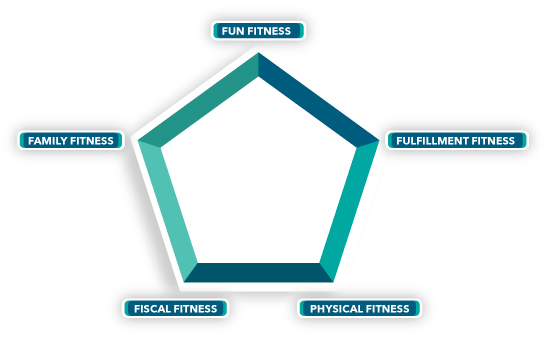
This is who I am, but I just need to keep it in check, not give it full rein to dominate and push out all other necessary and desirable elements of my mythical “well lived life”.
So now I had my 5 F’s! Not coincidentally, around this time in my life, I was influenced by my reading of Stephen Covey’s, “The 7 Habits of Highly Effective People”. Early in his book he stated that many executives he worked with had become burned-out in their early 40’s through their tireless pursuit of corporate success. He found it helpful for them to reconnect with their core values and to even write out their personal mission statements. Covey offered several examples of mission statements and often, executives listed their values hierarchically. For instance, a typical statement would say something like, “first comes God, then Family, etc…”
I wondered which of my F’s came first, or second, or third. I cherished all of my F’s. As a matter of fact, I thought that it had been my devaluation of fun that had led to some of my struggles. It occurred to me that no F trumped another. It felt a bit like heresy to think that “Fun” could stand on par with “Family” or “Fulfillment”, but I concluded that with the way my personal psychology worked, fun had to stand on par with the other F’s lest it yield a subversive, corruptive influence.
Putting F on par with all the rest of the F’s then led to the more general proposition that all the F’s needed to stand as equally influential elements in BALANCE! Balance became the organizing principal of the 5F’s, and Balance evolved into my more fundamental recommendation to my clients for emotionally healthy living.
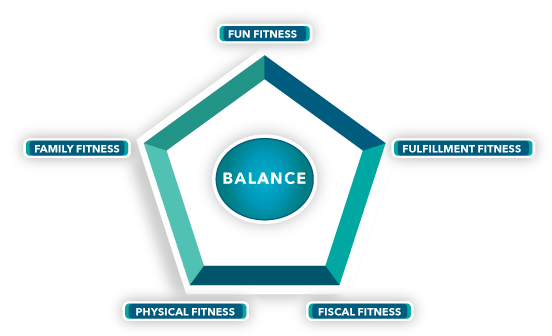
My 5 F’s are very personal to me. I don’t doubt that there can be value for others in the F’s that I stumbled upon throughout my life, but I don’t propose them as universal. There may be another F out there, or someone one else might find excellent guidance in the 4 S’s, or 6 G’s, or any number of letters in the alphabet that suits the fancy. But, I do recommend balance as a crucial element of mental health. It’s the balance of the 5 F’s that keeps me grounded, the perpetual tension amongst those elements that keeps me on my toes as I strive to attend to each and every one of them.
Now don’t get me wrong, I am almost never adequately attending to all 5 F’s at any one time. At my best I’m usually good with 3 of the F’s and struggling to attend to the other two. But, remember, I’m not a perfectionist. I don’t need to be in constant perfect balance. Balance is an aspiration, not a commandment!
In my mind’s eye, the 5 F’s are on something like a car’s steering wheel that I subtly adjust constantly to keep the car straight on the road. Too little exercise, I steer slightly to the left to get the “Fisical Fitness” straight. Late getting my taxes to my accountant because of a golf outing, steer a bit right to have better “Fiscal Fitness”. It’s perpetual wrestling with the powerful pull of each F that aims me toward my lifelong pursuit of balance.
There have been many occasions when I’ve presented the 5 F’s to very successful, high-powered executives and professionals. What I often sense from them, and they tend to confirm, is that Balance sounds a lot like Mediocrity. In fact, one of my clients recently told me that he had been goaded by a colleague to exhibit more single-minded obsessiveness if he wanted to be successful.
Until some future life in which I conduct psycho-biographical studies of great figures in history I can’t dispute the notion that obsessiveness is required for what we generally think of as greatness. Were any of Mt. Rushmore’s presidents balanced? How about great champions of justice such as Martin Luther King, Ghandi, and Mother Teresa. Do we think of our great athletes like Tiger Woods, Roger Federer, and Peyton Manning as even keel and well adjusted? Doubtful.
But, I argue that balance can yield greater mental health and personal satisfaction, and maybe many of the achievements that society and historians recognize as great. Yet, balance requires compromise and the possibility of falling short of complete attainment of any one goal in any one domain.
I recently asked a highly successful entrepreneur and CEO if instead of taking his company to the $100 million dollar plateau, as his background suggested was within his range, would he be happy if he attained only a $40 million dollar level, but had satisfaction and happiness in his family life? He had never juxtaposed the two in this manner before and the question definitely gave him pause. In the end, the latter of the two options did seem appealing, but he also squirmed and struggled with the imagined loss of a long held aspiration and dream. In this story we see both the costs and benefits of balance, and my contention here is that the benefit, for most of us, is worth the cost!
Dr. Bryan Nichols and Associates Psychological Services, Inc.
10700 Santa Monica Boulevard, Suite 315
Los Angeles, California 90025
310-284-8060